

When Jayden Nguyen ran out onto the SCG in Round 21 last year, he made history. He became the first Vietnamese player in the men’s AFL competition.
Amongst Essendon’s injury crisis, he was the fourteenth out of fifteen players to have their AFL debut last year. Essendon have since re-signed him and he is now an AFL Cultural Diversity Ambassador.
As a lifelong Hawthorn supporter, it pains me to give Essendon credit for anything. But as a Vietnamese person, it is incredibly special to see Jayden Nguyen play the game I’ve loved my whole life.
Because of this, I’ve been paying close attention to the way that people are talking about him.
The headlines
Last week, the ABC published a story about how Jayden Nguyen is the AFL’s first Vietnamese player. Let’s do a quick fact check of what they said.
The headline: ‘Jayden Nguyen may be a rookie but the AFL’s first Vietnamese player has already made his mark’.
Correct, if we take AFL to mean the men’s competition.
The story then includes the line, ‘Nguyen is the first player of Vietnamese heritage to play Aussie rules at the highest level.’
Incorrect. Well, hilariously, it is partially right. But it isn’t Jayden. The first player of Vietnamese heritage to play Aussie rules at the highest level was named Nguyen – specifically, Mai Nguyen, who played AFLW in 2017.
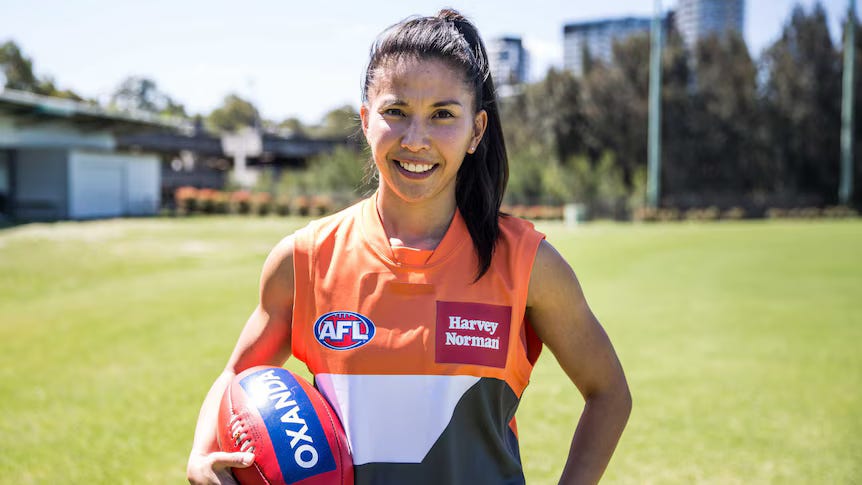
AFL? AFLM? AFLW?
Unfortunately, the language used in footy circles is pretty confusing at the moment.
This is due to the fact that upon the introduction of the women’s competition, the AFL (the organisation) chose to only gender language related to the women’s game. Officially, the men’s competition is known as ‘AFL’ and the women’s competition as ‘AFLW’.
I am not a fan of this as it suggests that men’s sport is the default and women’s sport is othered.
Dr Kasey Symons, Lecturer in Communication (Sports Media) at Deakin University and co-founder of Siren Sport, shares similar concerns about the thought process behind adding women’s programs and teams to competitions.
‘The process is exactly that, ‘adding’, not including and authentically embedding women’s teams into core business. As such, we usually end up with a ‘W’ assignment to women’s programs with the overall product, sport, code remaining unchanged and normalising sport as for men as the default, with women added in a secondary capacity. I find that divide deeply problematic,’ Dr Symons said.
Currently, ‘AFL’ has the following four meanings:
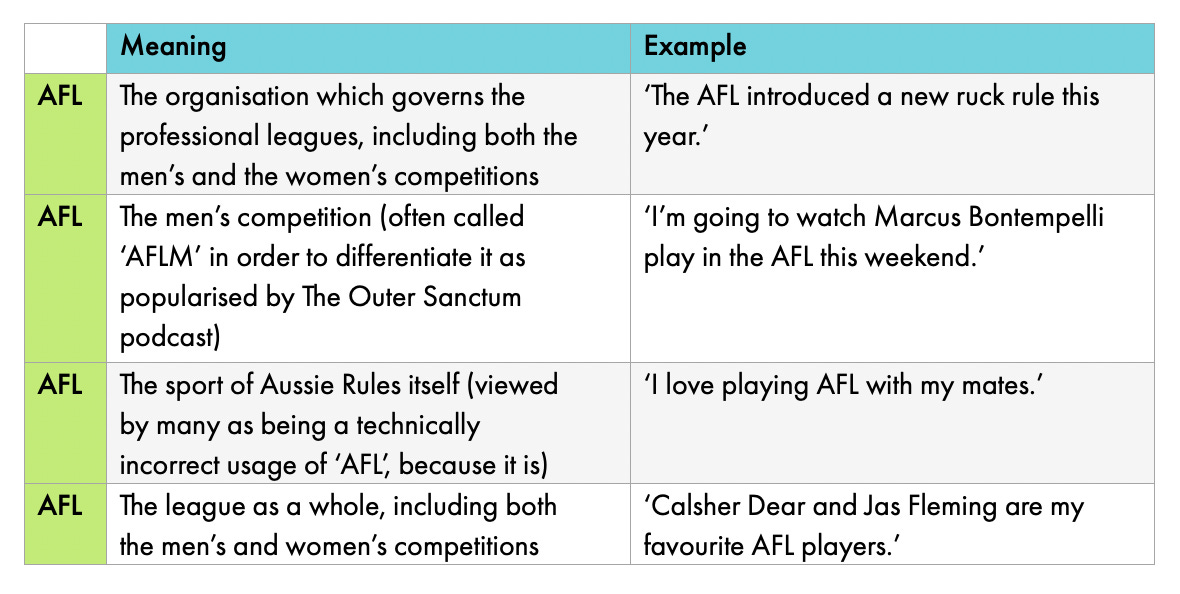
This means that it is technically correct to say that Jayden Nguyen is the first Vietnamese AFL player. He is the first men’s player, and the men’s competition is officially known as ‘AFL’ while the women’s is ‘AFLW’.
He is not, however, the first Vietnamese player in the entire league. To use the ABC’s wording from within the article, he is not ‘the first player of Vietnamese heritage to play Aussie rules at the highest level.’ Because Mai Nguyen did that by playing AFLW in 2017.
Why am I being so picky? You could argue that from the context of the article, it’s clear that the ABC is talking about the men’s competition.
However, I think that language is especially important when it has been used to exclude women from traditionally masculine sporting contexts for decades. The way we talk about sport reveals our sexist bias as a society: that men are the default and women are an afterthought.
‘There is a very active othering of women’s sport, just by the nature of women’s sport being referred to as ‘women’s sport’. We see this all the time in sports media and marketing of sport. The messages we receive constantly reinforce women’s sport as outside of the normalised sports environment, a men’s sporting environment, as something secondary,’ Dr Symons said.
These instances are common. Tennis player Andy Murray has gone viral several times for correcting a journalist in 2017 who claimed that Sam Querrey was the first US player to reach a major semi-final since 2009. Murray interrupted the journalist and said, ‘Male player.’ Murray was correct: Serena Williams, Venus Williams, Coco Vandeweghe, Madison Keys and Sloane Stephens had all made a major semi-final since 2009.
Just a couple of weeks ago, while I was watching the Winter Olympics, a commentator of the men’s ice hockey final remarked that it had been a long time since the US had won a gold medal in ice hockey. I thought, no it hasn’t: the US women won one literally three days ago.
Language in sport matters because it is used to make women in sport invisible.
Mai Nguyen
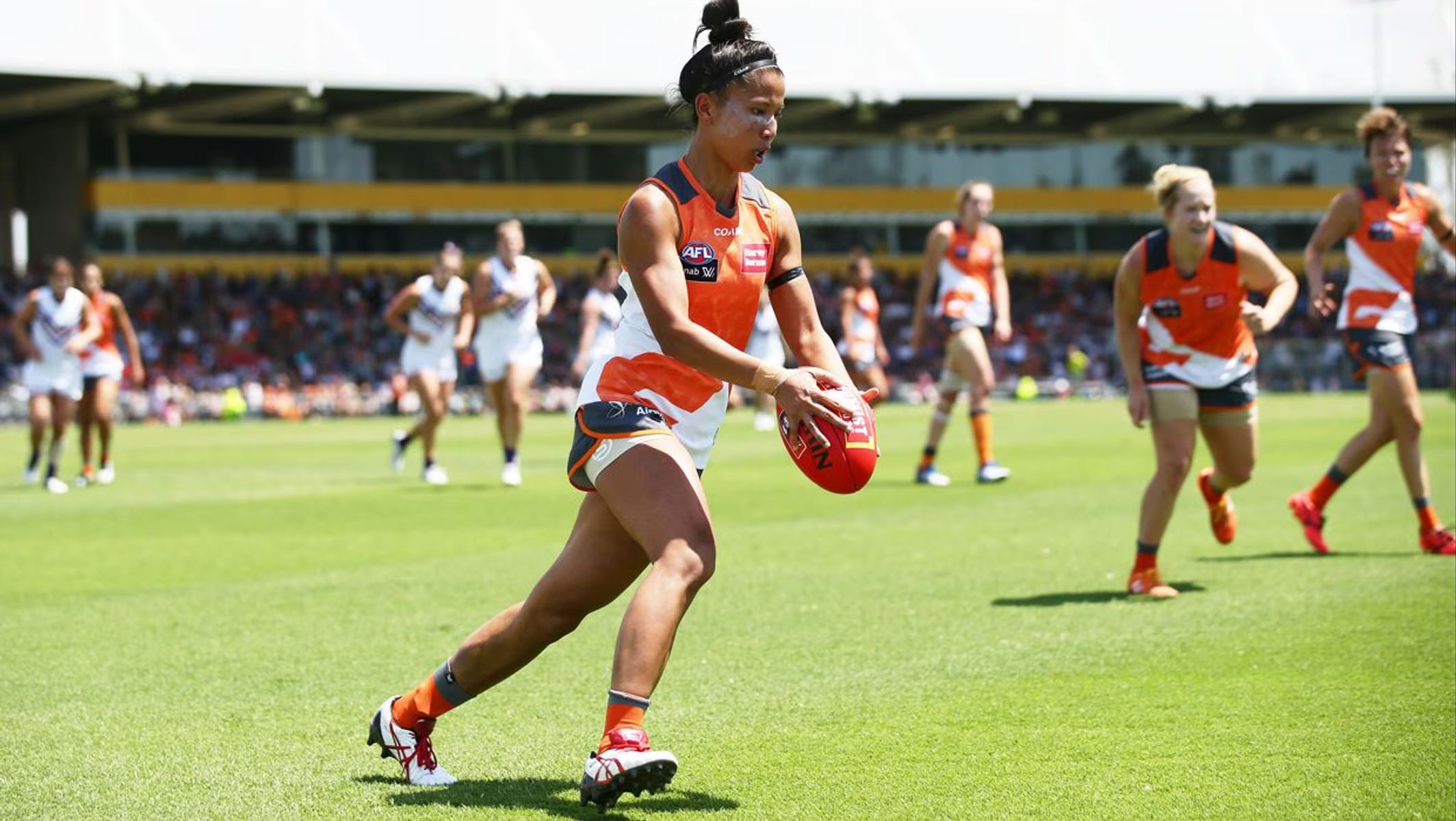
Let’s meet the first player of Vietnamese heritage to play Aussie rules at the highest level.
26-year-old Mai Nguyen was drafted at pick number 49 in the inaugural 2016 AFLW Draft by the Greater Western Sydney Giants. Her home club was the University of New South Wales-Eastern Suburbs Stingrays (now known as the Bulldogs).
The ABC described her as ‘a spritely, tenacious and exceptionally fit young woman’.
She made her debut in Round 2 of the inaugural 2017 season against Carlton at Princes Park, where GWS lost by thirteen points.
She played three games across Rounds 2 to 4, rupturing her ACL in the third game which put an end to her season. She was subsequently delisted by GWS.
Who cares?
Some people might read this and think, well, okay, why would we care about a woman who played three games and then got delisted? AFLW was barely a thing in 2017, whereas AFLM is a massive million-dollar force in 2026.
It matters because Mai Nguyen was part of history. She played three games of Aussie Rules at the highest level. That’s not nothing. That’s three more than me.
AFLW in 2017 was revolutionary. It is incredibly difficult to be the first at anything and Mai was part of the inaugural season. The inaugural draft. She was a pioneer. Every single player from that first season was.
According to the ABC, Mai likely did it for as little as $8 an hour. She continued to work ‘close to 30 part-time hours a week’ at her job as a physiotherapist in order to get by.
‘Australian rules football has such a great opportunity to bring more people into the game that has been predominantly played by white Australians. There is so much capacity for more inclusion so to see Vietnamese players coming into the AFLM and AFLW leagues is so powerful and hopefully signals to more people that this sport is a space they can be part of too,’ Dr Symons said.
But also, say that no one else does care. Guess what? I care. I’m a Vietnamese fan of Aussie Rules football. I think it’s very cool to see people like me play my favourite sport and hear them talk about their experiences using the same shared language as me.
Jayden and Mai have both described the struggles of reconciling Vietnamese cultural expectations with sport. Mai ‘used to sneak out and go to training’ and found it ‘very hard’ to tell her parents that she was going to pursue professional sport.
Jayden said, ‘The Asian stereotype is your parents want you to become a doctor, a dentist, a lawyer … those sorts of jobs’.
Like both of Jayden and Mai’s fathers, my mother came to Australia as a refugee from Vietnam.
Wrap up
I am so thrilled to see Jayden Nguyen play men’s AFL. I will cheer him on every week (except when he plays Hawthorn).
But let’s not erase women like Mai Nguyen from history – especially not when AFLW history is only just beginning.